

Introduction
Have you ever wondered why some websites appear on the first page of Google while others remain virtually invisible?
Every day, billions of searches are performed by people looking for answers, products, services, and solutions. Whether someone searches for “how to start a blog,” or “SEO agency near me,” search engines decide which websites deserve to appear first. Those decisions can determine whether a business receives thousands of visitors each month or struggles to attract any traffic at all.
That’s where Search Engine Optimization (SEO) becomes one of the most valuable digital marketing skills you can learn.
Complete SEO Guide is the practice of improving a website so it can rank higher in search engine results for relevant searches. The goal isn’t simply to increase rankings—it’s to attract the right audience, answer their questions, solve their problems, and create a better experience than competing websites.
Unlike paid advertising, where visibility disappears as soon as your budget runs out, SEO is a long-term investment. A well-optimized page can continue attracting qualified visitors, generating leads, and driving revenue long after it’s published. While SEO requires patience and consistent effort, its long-term return often makes it one of the most cost-effective marketing strategies available.
However, modern SEO is no longer about manipulating search engines.
Years ago, websites could rank by repeating the same keyword dozens of times or building thousands of low-quality backlinks. Those tactics may have worked temporarily, but today’s search engines are far more sophisticated. Google now evaluates hundreds of signals to understand whether a page is genuinely helpful, trustworthy, technically sound, and capable of satisfying the user’s search intent.
This shift has changed the way successful websites are built.
Today, effective SEO combines high-quality content, excellent user experience, strong website architecture, technical optimization, logical internal linking, page performance, and genuine authority. In other words, SEO is no longer a single technique—it’s the process of creating the best possible website for both users and search engines.
Whether you’re a beginner taking your first steps into digital marketing, a business owner looking to attract more customers, a blogger hoping to grow organic traffic, or a marketer wanting to strengthen your SEO knowledge, this guide has been created specifically for you.
You don’t need any previous SEO experience.
Each chapter builds upon the previous one, taking you from the fundamentals to more advanced concepts in a clear, practical, and easy-to-follow way. Instead of overwhelming you with technical jargon, we’ll focus on real-world examples, actionable strategies, and proven best practices that you can apply to your own website.
What You’ll Learn
By the time you finish this guide, you’ll be able to:
- Understand how search engines crawl, index, and rank web pages.
- Conduct keyword research based on search intent rather than guesswork.
- Optimize content using modern on-page SEO techniques.
- Build a technically healthy website that search engines can easily understand.
- Create content clusters that strengthen topical authority.
- Develop a smart internal linking strategy.
- Learn ethical link-building methods that improve authority over time.
- Improve local visibility for businesses targeting specific geographic areas.
- Measure SEO performance using industry-standard tools.
- Avoid outdated SEO practices that can hurt your rankings.
More importantly, you’ll understand why each strategy works—not just how to implement it.
Who Is This Guide For?
This guide is designed for anyone who wants to build sustainable organic growth, including:
- Beginners learning SEO for the first time.
- Small business owners looking to generate more leads.
- Bloggers aiming to increase organic traffic.
- Freelancers expanding their digital marketing skills.
- Marketing students building a strong SEO foundation.
- Website owners who want better visibility in search results.
Whether your goal is to rank a personal blog, grow an eCommerce store, or generate clients for your business, the principles in this guide remain the same.
Why This Guide Is Different
There are thousands of SEO articles available online, but many of them suffer from the same problems. Some are outdated, others focus on shortcuts, and many explain concepts without showing how they fit into a complete SEO strategy.
This guide takes a different approach.
Rather than treating SEO as a collection of isolated tactics, you’ll learn how every piece fits together—from keyword research and content creation to technical optimization, authority building, and user experience. You’ll see SEO as a complete system instead of a checklist.
Every chapter is written to provide practical value, helping you build skills that remain useful even as search engines continue to evolve.
A Simple Way to Think About SEO
Imagine opening two coffee shops on the same street.
Both serve excellent coffee.
One shop has a clear sign, an inviting entrance, organized seating, friendly staff, and customers who regularly recommend it to others.
The other shop has no sign, a confusing layout, poor service, and very few recommendations.
Which one is more likely to attract new customers?
Websites work in much the same way.
Your content represents the quality of your product, technical SEO ensures people can find and access it, user experience encourages visitors to stay, and backlinks act like recommendations that strengthen your credibility. When all these elements work together, your website becomes far more likely to earn higher rankings.
Before We Begin
SEO isn’t about chasing algorithms or finding secret ranking tricks.
It’s about understanding what users are searching for, creating content that genuinely helps them, and making your website the best answer available.
If you approach SEO with that mindset, every chapter in this guide will help you build a website that can grow steadily for years—not just until the next algorithm update.
Now that you understand why SEO matters, it’s time to begin with the most important question of all:
What is SEO, and how does it actually work?
Chapter 1: What Is SEO?

A few decades ago, finding information meant visiting a library, reading newspapers, or asking someone with expertise. Today, most people simply open Google, type a question, and expect an answer within seconds.
Whether someone searches for “best laptops under $1000,” “how to fix a slow website,” or “SEO agency near me,” search engines instantly return millions of results. Yet, most users never look beyond the first page. In fact, the websites appearing at the top receive the vast majority of clicks.
This is why SEO has become essential for every website.
What Does SEO Mean?
SEO (Search Engine Optimization) is the process of improving a website so that it appears higher in the organic (non-paid) results of search engines like Google, Bing, and other search platforms.
The purpose of SEO is not simply to increase rankings. Its real objective is to connect your website with people who are actively searching for the information, products, or services you provide.
For example:
- A local bakery wants to appear when people search for “birthday cakes near me.”
- A travel blog wants to rank for “best places to visit in Italy.”
- An SEO agency wants to appear for “technical SEO services.“
In each case, SEO helps the right audience discover the right website at the right time.
SEO Is More Than Rankings
Many beginners believe SEO is only about reaching Google’s first page. While rankings are important, they are only one part of the picture.
Modern SEO focuses on delivering value to users.
A successful SEO strategy aims to:
- Attract qualified visitors instead of random traffic.
- Answer users’ questions clearly and accurately.
- Provide a fast, secure, and mobile-friendly website.
- Build trust through helpful, reliable content.
- Encourage visitors to take meaningful actions, such as making a purchase, contacting a business, or subscribing to a newsletter.
A page that ranks well but fails to help users will struggle to maintain its position over time. Search engines increasingly reward websites that provide a positive user experience.
Organic Search vs Paid Search
One of the biggest misconceptions is that SEO and Google Ads are the same thing.
They are not.
| SEO (Organic Search) | Paid Search (PPC) |
|---|---|
| Earns rankings naturally | Pays for visibility |
| Clicks are free | Pay for every click |
| Long-term investment | Short-term results |
| Builds lasting authority | Stops when the budget ends |
| Requires continuous optimization | Requires continuous ad spend |
Many successful businesses use both strategies together. Paid advertising can deliver immediate visibility, while SEO builds sustainable long-term growth.
How SEO Benefits a Website
When SEO is implemented correctly, it can provide benefits that extend far beyond higher rankings.
Increased Visibility
The higher your pages appear in search results, the more likely people are to discover your website.
Qualified Traffic
SEO attracts visitors who are already searching for what you offer, making them more likely to engage with your content or become customers.
Greater Trust
Users often perceive websites ranking organically as more credible because they have earned their position rather than paid for it.
Better User Experience
Good SEO encourages faster loading times, clear navigation, mobile responsiveness, and high-quality content—all of which improve the experience for visitors.
Long-Term Growth
Unlike paid campaigns that stop generating traffic when spending ends, well-optimized pages can continue attracting visitors for months or even years with regular updates.
SEO Is a Continuous Process
A common mistake is to think SEO is something you do once and then forget.
In reality, SEO is an ongoing process.
Search engines update their algorithms, competitors publish new content, user behavior changes, and technology evolves. To remain competitive, websites need regular improvements, fresh content, and periodic technical audits.
Think of SEO as maintaining a garden. Planting seeds is only the beginning. Regular care, attention, and improvements are what allow it to grow over time.
Key Takeaways
Before moving to the next chapter, remember these essential points:
- SEO stands for Search Engine Optimization.
- The goal of SEO is to improve a website’s visibility in organic search results.
- Modern SEO focuses on helping users, not manipulating search engines.
- SEO combines content quality, technical optimization, user experience, and authority.
- Sustainable SEO is a long-term strategy that requires continuous improvement.
Next Chapter
Now that you understand what SEO is, the next question is equally important:
How do search engines actually find, understand, and rank billions of web pages?
In the next chapter, we’ll explore How Search Engines Work, including the three fundamental stages of crawling, indexing, and ranking.
Chapter 2: How Search Engines Work
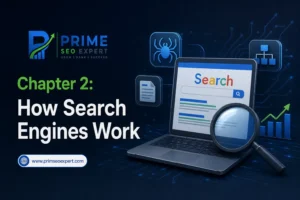
If you’ve ever searched for something on Google and received millions of results in less than a second, you might have wondered how search engines can find the right information so quickly.
The answer lies in a sophisticated process that continuously discovers, organizes, and evaluates billions of web pages across the internet.
Although search engines use highly advanced algorithms, the basic process can be understood through three fundamental stages:
- Crawling
- Indexing
- Ranking
Understanding these stages is one of the most important concepts in SEO because every optimization strategy ultimately supports one or more of these processes.
Let’s explore each stage in detail.
Stage 1: Crawling
Before a page can appear in search results, search engines first need to discover that it exists.
This process is called crawling.
Search engines use automated software programs known as web crawlers or bots (Google calls its primary crawler Googlebot) to travel across the web.
These crawlers move from one webpage to another by following links.
Think of Googlebot as an explorer traveling or a sports one through an enormous city. Every website is like a building, every webpage is a room, and every hyperlink is a road connecting one location to another. By following those roads, Googlebot continuously discovers new pages and revisits existing ones to check for updates.
Whenever you publish a new article, Google doesn’t instantly know it exists. It first needs to discover the page through one or more methods.
Google can discover pages through:
- Internal links from existing pages
- Backlinks from other websites
- XML sitemaps
- Previously crawled URLs
- Manual URL submission in Google Search Console
If your page has no links pointing to it and isn’t included in your sitemap, search engines may take much longer to find it—or may not discover it at all.
What Affects Crawling?
Several factors influence how easily search engines can crawl your website.
A Clear Site Structure
A logical website structure helps crawlers navigate your content efficiently. When pages are well-organized and connected through internal links, search engines can discover new content more easily.
Internal Linking
Every important page should be linked from other relevant pages. Orphan pages (pages with no internal links) are difficult for crawlers to find and may remain undiscovered for long periods.
XML Sitemap
An XML sitemap acts like a roadmap of your website, listing important URLs that search engines should crawl. While it doesn’t guarantee indexing, it helps crawlers discover content more efficiently.
Robots.txt
The robots.txt file tells search engine bots which areas of your website they can or cannot crawl. Incorrect settings may accidentally block important pages from being accessed.
Stage 2: Indexing
Discovering a page doesn’t automatically mean it will appear in Google Search.
After crawling a webpage, search engines analyze its content to decide whether it deserves to be stored in their database. This process is called indexing.
You can think of Google’s index as a massive digital library.
When a page is indexed, Google stores information about its content, headings, images, keywords, structured data, and other signals so it can retrieve that page when someone performs a relevant search.
However, not every crawled page gets indexed.
Search engines may choose not to index pages that are:
- Thin or low-quality.
- Duplicate or near-duplicate content.
- Blocked by a
noindexdirective. - Returning technical errors.
- Considered unhelpful or lacking unique value.
This is why publishing content alone isn’t enough. Your pages need to provide original, useful information that deserves a place in Google’s index.
How to Check if a Page Is Indexed
One simple method is to search:
site:yourdomain.com/page-urlIf Google displays the page, it has been indexed.
You can also verify indexing status in Google Search Console, which provides more detailed information and highlights any indexing issues.
Stage 3: Ranking
Once a page has been crawled and indexed, it becomes eligible to appear in search results.
This final stage is known as ranking.
When someone performs a search, Google evaluates billions of indexed pages and determines which ones are most likely to satisfy the user’s intent.
Rather than relying on a single factor, Google considers hundreds of signals to identify the most relevant and helpful results.
Some of the most important ranking signals include:
- Relevance to the search query.
- High-quality, original content.
- Search intent satisfaction.
- Website authority.
- Helpful internal linking.
- Mobile-friendly design.
- Fast page loading speed.
- Secure HTTPS connection.
- Positive user experience.
- Freshness of content when appropriate.
Google’s goal isn’t simply to return pages containing matching keywords—it’s to deliver the most useful answer for the user’s question.
A Simple Example
Imagine you publish an article titled:
“Complete Local SEO Guide for Small Businesses.”
Here’s what happens behind the scenes:
Step 1: Crawling
Googlebot discovers your new article through your XML sitemap and internal links.
Step 2: Indexing
Google analyzes the page, understands its topic, headings, images, and overall quality, then stores it in its search index.
Step 3: Ranking
When someone searches for “local SEO guide“, Google compares your article with thousands of similar pages and decides where it should appear based on relevance, quality, authority, and user experience.
This entire process—from discovery to ranking—can take anywhere from a few hours to several weeks, depending on various factors.
Why This Matters for SEO
Every SEO activity supports one or more of these three stages.
| SEO Activity | Supports Crawling | Supports Indexing | Supports Ranking |
|---|---|---|---|
| XML Sitemap | ✅ | ❌ | ❌ |
| Internal Linking | ✅ | ✅ | ✅ |
| High-Quality Content | ❌ | ✅ | ✅ |
| Schema Markup | ❌ | ✅ | ✅ |
| Fast Loading Speed | ❌ | ❌ | ✅ |
| Mobile-Friendly Design | ❌ | ❌ | ✅ |
| HTTPS Security | ❌ | ❌ | ✅ |
Understanding this relationship helps you see why SEO is much more than adding keywords to a page. Every improvement contributes to making your website easier to discover, understand, and trust.
Key Takeaways
Before moving to the next chapter, remember these core concepts:
- Search engines work through three main stages: Crawling, Indexing, and Ranking.
- Crawling is the process of discovering web pages.
- Indexing is the process of analyzing and storing pages in the search engine’s database.
- Ranking determines which indexed pages appear first for a user’s search.
- Strong technical SEO, quality content, and a well-structured website support all three stages and improve your chances of earning better visibility.
What’s Next?
Now that you understand how search engines work, the next step is to answer another important question:
Why should businesses and website owners invest time and effort in SEO instead of relying only on paid advertising?
In Chapter 3: Why SEO Is Important, we’ll explore the long-term benefits of SEO, how it drives sustainable growth, and why it’s considered one of the most valuable digital marketing investments for businesses of all sizes.
Chapter 3: Why SEO Is Important
You’ve learned what SEO is and how search engines discover, index, and rank web pages. The next question is just as important:
Why should businesses, bloggers, and website owners invest in SEO?
The answer is simple: your audience is already searching online.
Every day, people use search engines to find answers, compare products, discover local businesses, and solve problems. If your website appears when those searches happen, you have an opportunity to attract highly targeted visitors. If it doesn’t, those visitors will likely find one of your competitors instead.
SEO helps bridge that gap by making your website more visible to the people who are actively looking for what you offer.
SEO Brings the Right Audience
Not all website traffic is valuable.
A website with 100,000 random visitors may generate fewer sales than a website with 10,000 highly targeted visitors.
SEO focuses on attracting qualified organic traffic—people who are already interested in your products, services, or content.
For example:
- Someone searching for “best SEO guide for beginners” wants to learn SEO.
- Someone searching for “SEO agency for small business“ is looking to hire an agency.
- Someone searching for “technical SEO checklist” needs practical guidance.
Because users are actively searching, they are often much more likely to engage with your content than someone who sees a random advertisement.
SEO Builds Long-Term Visibility
One of the biggest advantages of SEO is its ability to generate sustainable traffic.
Paid advertising can bring visitors almost immediately, but traffic usually stops as soon as the advertising budget ends.
SEO works differently.
When you publish a high-quality page and continue improving it over time, that page can keep attracting visitors for months or even years. It becomes a long-term digital asset rather than a short-lived campaign.
Think of every well-written article as an investment. Instead of paying for every visitor, you build a library of content that continues working for your business long after it is published.
SEO Increases Trust and Credibility
People naturally trust websites that consistently appear in the organic search results.
Although high rankings don’t automatically guarantee quality, users often associate strong organic visibility with expertise and reliability.
Trust is built through a combination of factors, including:
- Helpful and accurate content.
- Secure HTTPS connections.
- Fast-loading pages.
- Clear website navigation.
- Positive user experience.
- Consistent brand reputation.
Over time, these elements strengthen your website’s credibility with both users and search engines.
SEO Supports Every Stage of the Customer Journey
SEO is not only useful when someone is ready to buy.
It can help users at every stage of their decision-making process.
| Customer Stage | Example Search | SEO Opportunity |
|---|---|---|
| Awareness | What is SEO? | Educational guides and blog posts |
| Consideration | Best SEO tools | Comparisons and in-depth reviews |
| Decision | SEO agency near me | Service pages, testimonials, and case studies |
This means a well-planned SEO Guide strategy can attract potential customers long before they make a purchasing decision.
SEO Delivers Better Return on Investment
SEO requires time, planning, and consistent effort, but its long-term value is one of its greatest strengths.
Instead of paying for every click, SEO helps you earn visibility by creating useful content and maintaining a technically sound website.
As your website gains authority, new pages often become easier to rank because search engines already recognize your domain as a trusted source.
This compounding effect makes SEO one of the most valuable long-term digital marketing strategies.
SEO Improves User Experience
Modern SEO is closely connected with user experience.
Google wants to recommend websites that are easy to use and genuinely helpful.
That means successful websites usually share several characteristics:
- Fast loading speed.
- Mobile-friendly design.
- Clear navigation.
- Readable content.
- Helpful internal links.
- Accessible page structure.
When visitors can quickly find the information they need, they are more likely to stay longer, explore additional pages, and return in the future.
SEO Helps Small Businesses Compete
A common misconception is that SEO only benefits large companies with massive marketing budgets.
In reality, SEO gives small businesses an opportunity to compete by focusing on relevance, expertise, and local search intent.
For example, a local accounting firm can rank for “tax consultant in Lahore”, while a neighborhood bakery may appear for “custom birthday cakes near me.”
By targeting specific audiences and creating genuinely helpful content, smaller businesses can often outperform larger competitors for niche searches.
SEO Is an Ongoing Strategy
SEO is not something you complete once.
Search behavior changes, competitors publish new content, technology evolves, and search engines regularly improve how they evaluate websites.
To maintain and improve rankings, websites should:
- Update existing content.
- Publish new articles regularly.
- Fix technical issues.
- Strengthen internal linking.
- Monitor performance using analytics tools.
Consistent improvement is what allows a website to grow steadily over time.
Key Takeaways
Before moving to the next chapter, remember these essential points:
- SEO connects your website with people who are actively searching for relevant information, products, or services.
- It attracts qualified organic traffic instead of random visitors.
- SEO is a long-term investment that can continue generating results long after content is published.
- Strong SEO improves visibility, credibility, and user experience.
- Businesses of all sizes can benefit from a well-planned SEO strategy.
What’s Next?
Now that you understand why SEO is important, it’s time to explore the four core areas that work together to improve a website’s visibility.
In Chapter 4: Types of SEO, you’ll learn the difference between On-Page SEO, Off-Page SEO, Technical SEO, and Local SEO, and how each contributes to building a successful SEO strategy.
Chapter 4: Types of SEO
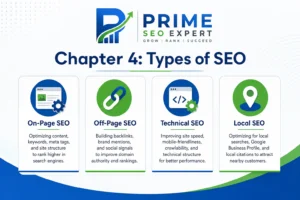
Now that you understand what SEO is, how search engines work, and why SEO is important, it’s time to explore the four main pillars that make up a successful SEO strategy.
Many beginners think SEO is simply about adding keywords to a webpage. In reality, modern SEO is much broader. It combines content quality, website performance, authority, and user experience to help search engines understand and trust your website.
To make SEO easier to understand, it can be divided into four primary categories:
- On-Page SEO
- Off-Page SEO
- Technical SEO
- Local SEO
Each type plays a different role, but they work together to improve your website’s visibility in search results.
Think of SEO as building a house.
- On-Page SEO is the quality of the rooms and interior.
- Technical SEO is the foundation and plumbing that keeps everything functioning properly.
- Off-Page SEO is your reputation in the neighborhood.
- Local SEO helps nearby customers find your house.
If one part is weak, the overall performance of your website can suffer.
1. On-Page SEO
On-Page SEO refers to everything you optimize directly on your website to help both users and search engines understand your content.
The goal is to create pages that are relevant, well-structured, easy to read, and capable of satisfying the user’s search intent.
Common On-Page SEO elements include:
- Keyword research and placement.
- SEO-friendly page titles.
- Compelling meta descriptions.
- Proper heading hierarchy (H1–H6).
- Clean URL structure.
- Internal linking.
- Image optimization.
- Helpful, original content.
- Schema markup where appropriate.
Imagine writing an article titled “Complete SEO Guide for Beginners.”
Even if the topic is excellent, poor headings, missing internal links, slow-loading images, and unclear page titles can make it difficult for search engines to understand its value.
Effective On-Page SEO ensures every page is organized, relevant, and useful.
2. Off-Page SEO
While On-Page SEO focuses on your website, Off-Page SEO involves activities that improve your website’s reputation across the internet.
The most well-known example is backlinks.
When reputable websites link to your content, search engines view those links as signals of credibility and authority.
However, modern Off-Page SEO goes far beyond simply collecting links.
It also includes:
- Digital PR.
- Brand mentions.
- Guest posting on relevant websites.
- Earning editorial backlinks.
- Online reputation management.
- Social visibility that increases brand awareness.
The emphasis should always be on earning high-quality, relevant mentions rather than building large numbers of low-quality links.
Quality consistently outweighs quantity.
3. Technical SEO
Technical SEO focuses on the behind-the-scenes elements that help search engines crawl, index, and understand your website efficiently.
Even the best content may struggle to rank if technical issues prevent search engines from accessing or interpreting it correctly.
Important areas of Technical SEO include:
- HTTPS security.
- XML sitemaps.
- Robots.txt configuration.
- Core Web Vitals.
- Mobile responsiveness.
- Page speed optimization.
- Canonical tags.
- Structured data.
- Fixing broken links and redirects.
Think of Technical SEO as maintaining the engine of a car.
A beautiful car with a damaged engine won’t perform well, just as excellent content won’t reach its full potential if technical problems exist.
4. Local SEO
Local SEO helps businesses appear in search results when users are looking for products or services within a specific geographic area.
For example:
- “SEO agency in Lahore”
- “Dentist near me”
- “Best coffee shop in Islamabad”
Search engines consider location when displaying these results, making Local SEO essential for businesses that serve customers in particular cities or regions.
Key components of Local SEO include:
- Google Business Profile optimization.
- Consistent business information (Name, Address, and Phone Number).
- Local citations.
- Customer reviews.
- Location-specific landing pages.
- Local keyword targeting.
For many local businesses, appearing in Google’s local results can generate highly qualified leads because users are often ready to contact or visit a business.
How These Four Types Work Together
Although each type of SEO has a different purpose, they are most effective when implemented together.
| SEO Type | Primary Goal | Examples |
|---|---|---|
| On-Page SEO | Optimize page content | Keywords, headings, internal links, images |
| Off-Page SEO | Build authority | Backlinks, Digital PR, brand mentions |
| Technical SEO | Improve website health | Speed, HTTPS, XML sitemap, schema |
| Local SEO | Increase local visibility | Google Business Profile, reviews, citations |
A website with excellent content but poor technical performance may struggle to rank.
Likewise, a technically perfect website with weak content or no authority is unlikely to achieve long-term success.
The strongest SEO strategies balance all four areas.
Which Type Should You Focus On First?
If you’re just starting your SEO journey, prioritize your efforts in this order:
- Technical SEO – Ensure your website can be crawled and indexed correctly.
- On-Page SEO – Create high-quality, search-intent-focused content.
- Content & Internal Linking – Build topical authority through well-connected articles.
- Off-Page SEO – Earn trustworthy backlinks and strengthen your reputation.
- Local SEO – Essential if your business targets a specific location.
This order creates a solid foundation before investing time in advanced strategies.
Key Takeaways
Before moving to the next chapter, remember these important points:
- SEO consists of four main categories: On-Page SEO, Off-Page SEO, Technical SEO, and Local SEO.
- Each category supports a different aspect of website visibility and organic growth.
- The best SEO results come from combining all four areas rather than focusing on just one.
- A successful SEO strategy begins with a technically healthy website and high-quality content, then builds authority and local relevance over time.
💡 Pro Tip: Many beginners spend months building backlinks before fixing technical issues or improving content quality. In most cases, a technically sound website with excellent content will outperform a poorly optimized website with dozens of low-quality backlinks.
What’s Next?
Now that you understand the four main types of SEO, it’s time to learn one of the most valuable skills in this entire SEO Guide:
Keyword Research.
In the next chapter, you’ll discover how to find the keywords your audience is actually searching for, understand search intent, evaluate keyword difficulty, and build a content strategy that targets the right opportunities.
Chapter 5: Keyword Research – The Foundation of Every Successful SEO Strategy
Imagine spending days writing an article that receives almost no visitors.
The content is well-written, the design looks professional, and you’ve followed basic SEO practices. Yet, months later, the page still struggles to attract organic traffic.
In many cases, the problem isn’t the quality of the writing—it’s that the content targets the wrong keywords.
This is why keyword research is often considered the foundation of every successful SEO strategy.
Before creating any page, blog post, or landing page, you need to understand what your audience is searching for, why they’re searching for it, and how competitive those searches are. Without this knowledge, you’re creating content based on assumptions instead of real search demand.
Keyword research removes the guesswork and helps you build content that matches what users are actively looking for.
What Is Keyword Research?
Keyword research is the process of discovering the words and phrases people type into search engines when looking for information, products, or services.
These search terms—commonly called keywords—help you understand your audience’s needs and create content that answers their questions.
For example, someone interested in learning SEO might search for:
- SEO Guide
- Complete SEO Guide
- SEO for Beginners
- Learn SEO
- How to Learn SEO
- What Is SEO
- Beginner SEO Tutorial
Although these searches are related, each reflects a slightly different intent. Understanding those differences allows you to create content that better satisfies the user’s expectations.
Why Keyword Research Matters
Choosing the right keyword is one of the most important decisions you’ll make before publishing any content.
Effective keyword research helps you:
- Discover what your audience is actually searching for.
- Identify topics with genuine search demand.
- Understand user intent before writing.
- Find realistic ranking opportunities.
- Build topical authority through related content.
- Create pages that attract qualified organic traffic.
Without proper research, even excellent content may struggle because it isn’t aligned with what users want.
Understanding Search Intent
One of the biggest mistakes beginners make is focusing only on keywords while ignoring search intent.
Search intent is the reason behind a search query.
Ask yourself:
What is the user hoping to achieve?
Google’s goal is to satisfy that intent. Your content should do the same.
There are four primary types of search intent.
1. Informational Intent
The user wants to learn something.
Examples:
- What is SEO?
- How does SEO work?
- SEO Guide for Beginners
The best content format is usually an in-depth guide, tutorial, or educational article.
2. Navigational Intent
The user wants to reach a specific website or brand.
Examples:
- Google Search Console
- Ahrefs login
- Semrush pricing
These searches usually don’t require informational blog posts.
3. Commercial Investigation
The user is researching before making a decision.
Examples:
- Best SEO tools
- Ahrefs vs Semrush
- Best SEO agencies
Comparison articles, reviews, and buying guides work well here.
4. Transactional Intent
The user is ready to take action.
Examples:
- Hire SEO expert
- Buy SEO course
- SEO services
These keywords are best targeted with service pages and landing pages.
Types of Keywords
Not all keywords are equal.
Understanding different keyword types helps you build a balanced SEO strategy.
Short-Tail Keywords
Examples:
- SEO
- Marketing
- Backlinks
These keywords have high search volume but are usually extremely competitive.
Long-Tail Keywords
Examples:
- Complete SEO Guide for Beginners
- How to Learn SEO Step by Step
- Best SEO Tools for Small Businesses
Long-tail keywords typically have lower competition and higher conversion potential because they reflect more specific user needs.
Branded Keywords
These include a company or product name.
Examples:
- Ahrefs SEO Guide
- Google Search Console
- Semrush Academy
Local Keywords
These target a geographic location.
Examples:
- SEO agency in Lahore
- Local SEO consultant
- Web design company near me
They are especially important for businesses serving customers in specific areas.
Search Volume vs Keyword Difficulty
Two important metrics influence keyword selection.
Search Volume
Search volume estimates how many times a keyword is searched during a given period.
Higher search volume often means greater potential traffic—but also stronger competition.
Keyword Difficulty
Keyword difficulty estimates how challenging it may be to rank for a particular keyword.
New websites should generally focus on lower-competition, long-tail opportunities before targeting highly competitive terms.
A balanced strategy considers both search volume and keyword difficulty rather than chasing high-volume keywords alone.
Building a Keyword List
A practical keyword strategy starts with one primary topic and expands into related searches.
Example:
Primary Topic
SEO Guide
Related keywords:
- Complete SEO Guide
- SEO Guide for Beginners
- Learn SEO
- SEO Basics
- Search Engine Optimization Guide
- How SEO Works
- SEO Checklist
- Beginner SEO Tutorial
These related terms help search engines understand the overall topic while allowing you to address multiple user questions within a single comprehensive guide.
Common Keyword Research Mistakes
Avoid these common mistakes:
- Choosing keywords based only on search volume.
- Ignoring search intent.
- Targeting highly competitive keywords too early.
- Stuffing keywords unnaturally into content.
- Creating multiple pages targeting the exact same keyword.
- Skipping competitor analysis.
- Publishing content without a keyword strategy.
Successful SEO isn’t about using more keywords—it’s about using the right keywords in the right context.
Best Keyword Research Tools
Several tools can simplify the research process:
| Tool | Best For |
|---|---|
| Google Keyword Planner | Keyword ideas |
| Google Search Console | Existing keyword performance |
| Google Trends | Seasonal trends |
| Ahrefs | Keyword research and competitor analysis |
| Semrush | Search volume and keyword difficulty |
| Ubersuggest | Beginner-friendly keyword research |
| AnswerThePublic | Question-based keyword ideas |
Each tool provides different insights, and using more than one often leads to better decisions.
Key Takeaways
- Keyword research is the foundation of every successful SEO strategy.
- Focus on understanding user intent—not just search volume.
- Use a mix of short-tail, long-tail, branded, and local keywords.
- Choose keywords that match your website’s authority and goals.
- Build content around topics rather than relying on a single keyword.
📌 Chapter Summary
Keyword research is far more than finding popular search terms. It helps you understand your audience, uncover their questions, and create content that matches their needs. A strong keyword strategy ensures that every article you publish has a clear purpose and a realistic opportunity to earn organic traffic.
💡 Pro Tip
Don’t chase the biggest keyword—chase the best opportunity. A new website has a much better chance of ranking for a specific long-tail keyword than a highly competitive broad term. As your site’s authority grows, you can gradually target more competitive keywords.
What’s Next?
Now that you know what people search for, the next step is learning how to optimize a page for those keywords.
In Chapter 6: On-Page SEO, you’ll learn how to optimize titles, headings, meta descriptions, URLs, images, internal links, and content structure to help both users and search engines understand your pages.
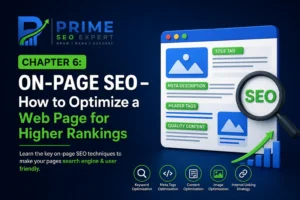
Chapter 6: On-Page SEO – How to Optimize a Web Page for Higher Rankings
Writing high-quality content is only half the battle. If search engines can’t understand your page—or if users struggle to navigate it—even the best content may fail to achieve its full ranking potential.
This is where On-Page SEO becomes essential.
On-Page SEO is the process of optimizing the individual elements of a webpage so that both users and search engines can easily understand its purpose, relevance, and value.
Unlike Off-Page SEO, which focuses on external signals such as backlinks, On-Page SEO is completely under your control. Every title, heading, image, paragraph, and internal link contributes to how search engines evaluate your content.
A well-optimized page doesn’t just rank better—it also delivers a better experience for visitors, increasing engagement, trust, and conversions.
What Is On-Page SEO?
On-Page SEO refers to all the optimizations you make within a webpage to improve its visibility in organic search results.
These optimizations help search engines answer three important questions:
- What is this page about?
- Is this page relevant to the user’s search?
- Does this page provide enough value to deserve a high ranking?
When the answer to all three questions is “yes,” your chances of ranking improve significantly.
The Core Elements of On-Page SEO
Successful On-Page SEO isn’t about one trick—it’s about optimizing multiple elements that work together.
Let’s explore the most important ones.
1. Create a Strong SEO Title
The page title is one of the strongest relevance signals for search engines.
A good title should:
- Include the primary keyword naturally.
- Clearly describe the page.
- Encourage users to click.
- Stay within approximately 50–60 characters.
Good Example
Complete SEO Guide for Beginners: Learn SEO Step by Step
Poor Example
SEO | SEO Guide | Best SEO Guide | Learn SEO | SEO Tips
The second example repeats keywords unnaturally and provides little value to readers.
2. Write an Effective Meta Description
Although the meta description isn’t a direct ranking factor, it strongly influences click-through rate (CTR).
A good meta description should:
- Summarize the page.
- Include the primary keyword naturally.
- Encourage users to click.
- Stay within 150–160 characters.
Example
Learn SEO from scratch with this complete SEO guide covering keyword research, on-page SEO, technical SEO, link building, and practical optimization strategies.
3. Use a Proper Heading Structure
Headings organize your content for both readers and search engines.
A logical hierarchy improves readability and helps search engines understand the page.
A typical structure looks like this:
H1
│
├── H2
│     ├── H3
│     ├── H3
│
├── H2
│     ├── H3
│
└── H2
Use only one H1 per page and organize the remaining sections with H2, H3, and H4 headings where appropriate.
4. Optimize Your URL
A clean URL is easier for users to read and helps search engines understand the page topic.
Good
example.com/complete-seo-guidePoor
example.com/post?id=274&cat=seo-guide-final-versionBest practices:
- Keep URLs short.
- Use descriptive words.
- Separate words with hyphens.
- Avoid unnecessary numbers and dates.
5. Place Keywords Naturally
Many beginners believe that repeating a keyword dozens of times improves rankings.
It doesn’t.
Modern search engines understand context and related terms.
Instead of forcing the keyword repeatedly, place it naturally in important locations:
- Title tag.
- H1 heading.
- First paragraph.
- Selected H2 headings.
- Meta description.
- Image alt text (when relevant).
- Conclusion.
Remember: write for people first, then optimize for search engines.
6. Improve Content Readability
Even excellent information loses value if it’s difficult to read.
Improve readability by:
- Writing short paragraphs.
- Using descriptive headings.
- Adding bullet points.
- Including numbered lists.
- Highlighting important ideas where appropriate.
- Avoiding unnecessary jargon.
Well-structured content keeps visitors engaged and encourages them to continue reading.
7. Optimize Images
Images improve user experience, but they should also be optimized.
Best practices include:
- Use descriptive file names.
- Add meaningful alt text.
- Compress large images.
- Choose modern image formats where appropriate.
- Use images that genuinely support the content.
Avoid uploading unnecessarily large files that slow down page loading.
8. Build a Strong Internal Linking Structure
Internal links connect one page of your website to another.
They help:
- Search engines discover new pages.
- Distribute authority across your website.
- Keep visitors engaged longer.
- Strengthen topical authority.
For example, within this SEO Guide, future chapters can naturally link to dedicated guides on:
- Technical SEO
- Keyword Research
- Local SEO
- Link Building
- SEO Audit
This creates a logical content network that benefits both readers and search engines.
9. Match Search Intent
Every successful page answers the question behind the search.
For example:
Search:
“Complete SEO Guide”
The user expects:
- A comprehensive explanation.
- Beginner-friendly language.
- Practical examples.
- Step-by-step learning.
If your content doesn’t satisfy those expectations, rankings become much harder to achieve.
Always create content that matches the user’s intent—not just the keyword.
10. Add Structured Data
Structured data (Schema Markup) helps search engines better understand your content.
Depending on the page, useful schema types include:
- Article
- FAQ
- Breadcrumb
- Organization
- Local Business
While schema doesn’t guarantee higher rankings, it can improve how your pages appear in search results and increase visibility.
On-Page SEO Checklist
Before publishing any page, ask yourself:
| Checklist Item | Status |
|---|---|
| One H1 only | ✅ |
| Primary keyword in title | ✅ |
| Optimized meta description | ✅ |
| Clean URL | ✅ |
| Proper heading hierarchy | ✅ |
| Internal links added | ✅ |
| Images optimized | ✅ |
| Mobile-friendly layout | ✅ |
| Readable formatting | ✅ |
| Search intent satisfied | ✅ |
Following this checklist consistently helps ensure that every page is technically and structurally prepared for search engines.
Key Takeaways
- On-Page SEO focuses on optimizing the elements within your webpage.
- Strong titles, headings, URLs, and internal links improve both usability and search visibility.
- Keyword placement should be natural and user-focused.
- Readability and search intent are just as important as technical optimization.
- Consistency across all on-page elements creates a stronger foundation for long-term rankings.
📌 Chapter Summary
On-Page SEO is where great content meets smart optimization. By improving titles, headings, URLs, internal links, images, and page structure, you make it easier for search engines to understand your content while creating a better experience for readers. Small improvements across multiple on-page elements often produce stronger results than relying on a single SEO tactic.
💡 Pro Tip
Before publishing any page, search your target keyword on Google and study the top-ranking results. Analyze their headings, search intent, content depth, and page structure—not to copy them, but to create something more complete, more helpful, and easier to understand. That’s how truly competitive pages are built.
What’s Next?
Now that you’ve learned how to optimize the visible elements of a webpage, it’s time to explore the technical side of SEO.
In Chapter 7: Technical SEO, you’ll learn how XML sitemaps, robots.txt, Core Web Vitals, HTTPS, canonical tags, crawlability, and indexing work together to ensure search engines can efficiently discover, understand, and rank your website.
Chapter 7: Technical SEO – Building a Strong Foundation for Search Engines

Imagine building a beautiful house with modern furniture, elegant decoration, and high-quality materials—but the foundation is weak. No matter how attractive the house looks, structural problems will eventually appear.
The same principle applies to websites.
You may publish outstanding content, target the right keywords, and earn valuable backlinks, but if search engines struggle to crawl, index, or understand your website, your SEO efforts will never reach their full potential.
This is where Technical SEO plays a critical role.
Technical SEO focuses on optimizing your website’s infrastructure so search engines can efficiently discover, understand, and rank your content. While visitors may never notice many of these optimizations, search engines rely on them every day.
Think of Technical SEO as the engine of a car. It may not be visible from the outside, but it determines how smoothly everything works.
What Is Technical SEO?
Technical SEO refers to the process of improving your website’s technical structure to help search engines crawl, index, and interpret your pages effectively.
Unlike On-Page SEO, which focuses on content, headings, and keywords, Technical SEO deals with the systems working behind the scenes.
Its primary goals are to:
- Improve crawlability.
- Ensure proper indexing.
- Enhance website performance.
- Strengthen security.
- Deliver a better user experience.
Without a technically healthy website, even exceptional content can struggle to rank.
Why Technical SEO Matters
Search engines want to provide users with fast, secure, and reliable websites.
If your site loads slowly, contains broken links, or prevents search engines from accessing important pages, it becomes more difficult to compete with technically optimized websites.
Technical SEO helps:
- Improve search engine crawling.
- Increase indexing efficiency.
- Reduce technical errors.
- Enhance page speed.
- Improve mobile usability.
- Strengthen overall website quality.
These improvements benefit both search engines and your visitors.
1. Website Crawlability
Before Google can rank your pages, it must first discover them.
Crawlability refers to how easily search engine bots can access and navigate your website.
A website with logical navigation, clean internal linking, and a clear structure makes crawling much easier.
To improve crawlability:
- Create a logical site structure.
- Use descriptive internal links.
- Fix broken links.
- Avoid orphan pages.
- Maintain an updated XML sitemap.
The easier it is for search engines to explore your website, the more efficiently they can discover new and updated content.
2. XML Sitemap
An XML sitemap is a file that lists the important pages on your website.
Think of it as a roadmap for search engines.
Although Google can often discover pages through internal links, a sitemap helps ensure that important URLs are found more quickly.
A good sitemap should:
- Include only important indexable pages.
- Update automatically when new content is published.
- Exclude duplicate or low-value URLs.
- Be submitted through Google Search Console.
Most modern SEO plugins generate XML sitemaps automatically, making this an easy but essential technical optimization.
3. Robots.txt
The robots.txt file tells search engine crawlers which parts of your website they can or cannot access.
For example, you may want to block administrative pages while allowing blog posts and service pages to be crawled.
However, incorrect robots.txt settings can accidentally prevent Google from accessing valuable content.
Always review changes carefully before publishing them.
4. HTTPS Security
Website security is a fundamental ranking signal.
HTTPS encrypts the connection between your website and its visitors, protecting sensitive information and improving trust.
Today, users expect every professional website to use HTTPS.
If your website still loads over HTTP, upgrading to HTTPS should be one of your highest priorities.
Benefits include:
- Improved security.
- Greater user trust.
- Better browser compatibility.
- Stronger SEO foundation.
5. Website Speed
Users expect websites to load almost instantly.
If a page takes too long to appear, many visitors leave before reading any content.
Slow websites often experience:
- Higher bounce rates.
- Lower engagement.
- Reduced conversions.
- Poor user satisfaction.
Improve page speed by:
- Compressing images.
- Using modern image formats.
- Enabling browser caching.
- Minimizing unnecessary scripts.
- Choosing reliable hosting.
- Optimizing CSS and JavaScript.
Small performance improvements can significantly enhance the overall user experience.
6. Mobile-Friendly Design
More people now browse the web using smartphones than desktop computers.
Google primarily evaluates the mobile version of a website when determining rankings.
A mobile-friendly website should:
- Adapt to different screen sizes.
- Use readable font sizes.
- Provide touch-friendly navigation.
- Avoid horizontal scrolling.
- Load quickly on mobile networks.
Responsive design is no longer optional—it’s essential.
7. Canonical Tags
Sometimes similar or duplicate pages exist on a website.
Canonical tags tell search engines which version should be treated as the primary page.
For example, these URLs may display the same content:
- example.com/page
- www.example.com/page
- example.com/page?ref=homepage
A canonical tag helps consolidate ranking signals and prevents duplicate content issues.
8. Structured Data (Schema Markup)
Structured data provides additional context about your content.
It helps search engines understand whether a page is:
- An article.
- A product.
- A local business.
- A frequently asked questions page.
- A review.
Proper schema implementation may improve how your pages appear in search results by enabling rich results such as FAQs, ratings, breadcrumbs, and other enhanced features.
9. Core Web Vitals
Core Web Vitals measure the real-world user experience of your website.
Google evaluates three key areas:
| Metric | Measures |
|---|---|
| Largest Contentful Paint (LCP) | Loading performance |
| Interaction to Next Paint (INP) | Responsiveness to user interactions |
| Cumulative Layout Shift (CLS) | Visual stability while loading |
A technically optimized website aims to provide a fast, stable, and responsive experience across all devices.
10. Fix Technical Errors
Regular website maintenance is an essential part of Technical SEO.
Common issues include:
- Broken links (404 errors).
- Redirect chains.
- Duplicate pages.
- Missing meta tags.
- Server errors.
- Mixed content warnings.
- Slow-loading pages.
Routine technical audits help identify and resolve these problems before they negatively impact search performance.
Technical SEO Checklist
Before considering your website technically optimized, confirm the following:
| Checklist Item | Status |
|---|---|
| HTTPS enabled | ✅ |
| XML sitemap submitted | ✅ |
| Robots.txt configured correctly | ✅ |
| Mobile-friendly design | ✅ |
| Fast loading speed | ✅ |
| Internal links working | ✅ |
| Canonical tags implemented | ✅ |
| Structured data added | ✅ |
| Core Web Vitals optimized | ✅ |
| Technical errors monitored | ✅ |
Key Takeaways
- Technical SEO ensures search engines can efficiently crawl, index, and understand your website.
- A strong technical foundation improves both rankings and user experience.
- Website speed, security, mobile usability, and structured data all contribute to long-term SEO success.
- Regular technical audits help prevent issues that may reduce search visibility.
📌 Chapter Summary
Technical SEO works behind the scenes, but its impact is visible in every aspect of your website’s performance. A technically optimized website is easier to crawl, faster to load, more secure, and better prepared to compete in search results. Before investing heavily in content or link building, make sure your technical foundation is solid.
💡 Pro Tip
Many websites don’t lose rankings because of poor content—they lose them because of unresolved technical issues. Schedule a technical SEO audit every few months to identify crawl errors, broken links, indexing problems, and performance issues before they affect your organic traffic. Preventing problems is always easier than recovering lost rankings.
What’s Next?
Now that your website has a strong technical foundation, the next step is learning how to create content that search engines trust and users genuinely value.
In Chapter 8: Content Strategy & EEAT, you’ll discover how to build topical authority, satisfy search intent, create content clusters, and align your content with Google’s principles of Experience, Expertise, Authoritativeness, and Trustworthiness (EEAT).
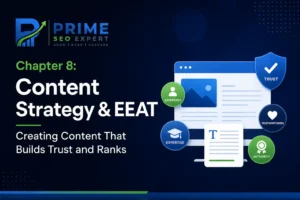
Chapter 8: Content Strategy & EEAT – Creating Content That Builds Trust and Ranks
Imagine two websites publishing articles on the same topic.
Both target the same keyword, both have similar page speed, and both follow basic SEO practices.
However, one article consistently ranks higher, earns more backlinks, attracts returning visitors, and maintains its position for years.
Why?
Because modern search engines evaluate far more than keywords. They aim to understand which content genuinely helps users, demonstrates expertise, and deserves to be trusted.
This is why content strategy has become one of the most important aspects of SEO.
Publishing articles without a clear plan may generate occasional traffic, but a structured content strategy helps you build topical authority, satisfy user intent, and establish your website as a trusted resource within your niche.
What Is a Content Strategy?
A content strategy is a long-term plan for creating, organizing, publishing, and updating content that aligns with both user needs and business goals.
Instead of writing random blog posts, every article should support a broader objective.
A well-planned strategy answers questions such as:
- What topics should we cover?
- Who is our target audience?
- Which keywords should we prioritize?
- How do articles connect through internal links?
- Which content should become cornerstone resources?
When every piece of content has a purpose, your website grows into a valuable knowledge hub rather than a collection of unrelated pages.
Why High-Quality Content Matters
Search engines exist to help users find the best possible answers.
If your content provides clear explanations, solves problems, and offers genuine value, it has a much better chance of earning visibility.
High-quality content typically:
- Answers the user’s question completely.
- Uses accurate and up-to-date information.
- Demonstrates real expertise.
- Is easy to read and well organized.
- Includes examples, visuals, or practical advice.
- Encourages users to explore additional content.
Quality isn’t measured by word count alone—it’s measured by usefulness.
A concise article that completely satisfies user intent often performs better than a lengthy article filled with unnecessary repetition.
Understanding Search Intent
Every search begins with a purpose.
Before creating content, ask yourself:
“What is the user actually trying to accomplish?”
For example:
| Search Query | Likely Intent | Best Content Format |
|---|---|---|
| What is SEO? | Learn | Educational guide |
| Best SEO tools | Compare | Review or comparison article |
| Hire SEO agency | Take action | Service page |
| Technical SEO checklist | Solve a problem | Step-by-step checklist |
When your content matches the user’s intent, visitors stay longer, engage more, and are more likely to return.
Build Topical Authority
Search engines increasingly reward websites that demonstrate deep knowledge about a subject.
This concept is known as Topical Authority.
Instead of publishing isolated articles on unrelated topics, successful websites cover a subject from multiple angles.
For example, a website focused on SEO might publish:
- Complete SEO Guide
- Keyword Research Guide
- On-Page SEO Guide
- Technical SEO Guide
- Link Building Guide
- Local SEO Guide
- SEO Audit Checklist
- Google Search Console Guide
When these articles are connected through internal links, they signal to search engines that your website is a comprehensive resource on SEO.
This approach is far more effective than publishing random articles across unrelated topics.
The Power of Content Clusters
One of the best ways to build topical authority is by using a pillar-and-cluster strategy.
The pillar page covers a broad topic in depth.
Supporting cluster articles explore individual subtopics in greater detail.
Example:
Pillar Page
Complete SEO Guide
Supporting Cluster Articles
- Keyword Research Guide
- Technical SEO Guide
- On-Page SEO Guide
- Local SEO Guide
- Link Building Guide
- SEO Audit Guide
- SEO Tools Guide
Every cluster article links back to the pillar page, while the pillar page links to all supporting articles.
This creates a strong internal linking structure that benefits both users and search engines.
Understanding EEAT
Google uses the concept of EEAT to evaluate the overall quality and trustworthiness of content.
EEAT stands for:
Experience
Has the author demonstrated first-hand knowledge or practical experience with the topic?
Real examples, case studies, and personal insights strengthen credibility.
Expertise
Does the content reflect genuine knowledge?
Accurate explanations, practical guidance, and subject expertise help establish authority.
Authoritativeness
Is the website recognized as a reliable source?
Strong branding, quality backlinks, citations, and topical authority all contribute to authoritativeness.
Trustworthiness
Can users trust the website?
Trust is built through:
- Accurate information.
- Transparent authorship.
- Secure HTTPS.
- Clear contact information.
- Honest claims.
- Regular content updates.
Among all four elements, trustworthiness is the foundation. Without trust, expertise and authority have far less impact.
Keep Your Content Fresh
Publishing an article isn’t the end of the process.
Content should be reviewed and updated regularly.
Updates may include:
- New statistics.
- Improved examples.
- Better visuals.
- Updated screenshots.
- Additional FAQs.
- New internal links.
- Recent industry developments.
Fresh, accurate content remains valuable to both readers and search engines.
Common Content Strategy Mistakes
Avoid these mistakes:
- Publishing without keyword research.
- Ignoring search intent.
- Creating duplicate content.
- Covering too many unrelated topics.
- Neglecting internal linking.
- Never updating older articles.
- Prioritizing quantity over quality.
Long-term SEO success comes from consistently creating content that solves real problems—not simply increasing the number of published pages.
Content Strategy Checklist
Before publishing new content, ask yourself:
| Checklist Item | Status |
|---|---|
| Targets a clear keyword | ✅ |
| Matches search intent | ✅ |
| Provides original value | ✅ |
| Uses logical headings | ✅ |
| Includes internal links | ✅ |
| Demonstrates expertise | ✅ |
| Supports topical authority | ✅ |
| Updated and accurate | ✅ |
| Easy to read | ✅ |
| Encourages further exploration | ✅ |
Key Takeaways
- A content strategy ensures every article has a clear purpose.
- Search intent should guide every piece of content you create.
- Topical authority is built by covering a subject comprehensively.
- Content clusters strengthen internal linking and website relevance.
- EEAT helps establish credibility and long-term trust with both users and search engines.
📌 Chapter Summary
Modern SEO is no longer about publishing as many articles as possible. Success comes from creating genuinely helpful content, organizing it into topic clusters, and demonstrating experience, expertise, authority, and trust. A well-planned content strategy turns individual articles into a complete knowledge ecosystem that benefits readers and strengthens search visibility.
💡 Pro Tip
Don’t ask, “What article should I publish next?” Ask, “What question does my audience still need answered?” When every new article fills a knowledge gap and connects to your existing content, your website grows into an authority—not just another blog.
What’s Next?
Now that you’ve learned how to create valuable, trustworthy content, it’s time to discover how other websites can strengthen your authority.
In Chapter 9: Link Building, you’ll learn the difference between good and bad backlinks, ethical link-building strategies, digital PR, anchor text best practices, and how to earn links that improve long-term rankings.
Chapter 9: Link Building – How to Earn High-Quality Backlinks That Improve SEO

Imagine two websites publishing equally helpful content on the same topic.
Both are well-written, technically optimized, mobile-friendly, and satisfy the user’s search intent. Yet one consistently outranks the other.
One of the biggest reasons for this difference is authority.
Search engines evaluate not only the quality of your content but also how other websites respond to it. When trusted websites link to your pages, they act as signals that your content is valuable, reliable, and worth recommending.
These signals are known as backlinks, and earning them is one of the core objectives of modern link building.
However, today’s SEO is very different from the early days of search engines. Building hundreds of low-quality links is no longer an effective strategy. In fact, it can do more harm than good.
Successful link building is about earning trust—not manipulating rankings.
What Is Link Building?
Link building is the process of acquiring hyperlinks from other websites that point to your own pages.
These incoming links, commonly called backlinks, help search engines discover your content and evaluate your website’s authority.
Think of each quality backlink as a professional recommendation.
If respected websites consistently reference your content, search engines gain confidence that your pages provide valuable information.
Why Backlinks Matter
Backlinks remain one of the strongest indicators of authority because they represent independent recommendations from other websites.
High-quality backlinks can help:
- Increase website authority.
- Improve search visibility.
- Drive referral traffic.
- Help search engines discover new pages.
- Strengthen brand credibility.
- Support long-term organic growth.
However, not every backlink has equal value.
One relevant link from a respected website can be more beneficial than hundreds of links from low-quality sources.
Quality Over Quantity
One of the biggest SEO myths is that more backlinks always lead to higher rankings.
Modern search engines focus far more on quality than quantity.
A valuable backlink usually comes from a website that is:
- Relevant to your niche.
- Trusted by users.
- Frequently updated.
- Editorially controlled.
- Naturally linked.
For example, if you publish an in-depth SEO resource, a backlink from a respected digital marketing website is generally far more valuable than dozens of links from unrelated directories.
Types of Backlinks
Not every backlink is earned in the same way.
Editorial Links
These are naturally earned when another website references your content because it provides genuine value.
They are considered among the strongest types of backlinks.
Guest Post Links
Writing high-quality articles for relevant websites can help you build authority while reaching a new audience.
The emphasis should always be on contributing useful content—not simply acquiring links.
Resource Page Links
Many websites maintain curated resource pages.
If your guide provides exceptional value, it may be included as a recommended resource.
Digital PR Links
Publishing original research, surveys, industry insights, or unique case studies can attract attention from journalists and publishers.
These links are often among the most authoritative because they are earned through genuinely newsworthy content.
Internal Links vs Backlinks
Many beginners confuse internal links with backlinks.
They serve different purposes.
| Internal Links | Backlinks |
|---|---|
| Connect pages within your own website | Come from external websites |
| Help users navigate | Build authority and trust |
| Improve crawlability | Strengthen domain reputation |
| Fully under your control | Must be earned naturally |
Both are essential components of a complete SEO strategy.
Anchor Text Best Practices
Anchor text is the clickable text used in a hyperlink.
Good anchor text clearly describes the destination page.
Examples:
✅ Complete SEO Guide
✅ Technical SEO Checklist
✅ Keyword Research Guide
Poor examples include:
❌ Click Here
❌ Read More
❌ This Page
Natural, descriptive anchor text helps users understand what to expect before clicking.
Link Building Strategies That Work
Rather than chasing shortcuts, focus on sustainable methods.
Publish Exceptional Content
Comprehensive guides, original research, and practical resources naturally attract more links than thin content.
Create Linkable Assets
Examples include:
- Industry statistics.
- Free tools.
- Checklists.
- Templates.
- Infographics.
- Original case studies.
These resources provide ongoing value and encourage other websites to reference your work.
Guest Blogging
Contribute valuable articles to reputable websites within your industry.
Prioritize quality publications that serve a relevant audience.
Build Relationships
Networking with publishers, bloggers, journalists, and industry experts often creates opportunities for natural mentions and collaborations.
Strong relationships frequently lead to stronger backlinks over time.
Link Building Mistakes to Avoid
Avoid practices that attempt to manipulate search rankings.
These include:
- Buying backlinks.
- Participating in link farms.
- Excessive link exchanges.
- Automated link-building software.
- Spam blog comments.
- Irrelevant directory submissions.
- Keyword-stuffed anchor text.
These tactics may produce short-term gains but can damage your website’s long-term credibility.
Monitor Your Backlink Profile
Backlink building isn’t a one-time activity.
Regularly monitor:
- New backlinks.
- Lost backlinks.
- Referring domains.
- Anchor text distribution.
- Broken backlinks.
- Competitor link opportunities.
Maintaining a healthy backlink profile helps you understand what’s working and where future opportunities exist.
Link Building Checklist
Before starting any campaign, ask yourself:
| Checklist Item | Status |
|---|---|
| Content provides unique value | ✅ |
| Website is technically optimized | ✅ |
| Internal linking is strong | ✅ |
| Outreach targets relevant websites | ✅ |
| Anchor text is natural | ✅ |
| Links are earned ethically | ✅ |
| Backlink profile monitored regularly | ✅ |
| Focus on quality over quantity | ✅ |
| Avoid manipulative tactics | ✅ |
| Long-term strategy in place | ✅ |
Key Takeaways
- Link building is about earning trust and authority—not collecting random links.
- High-quality backlinks are more valuable than a large number of low-quality ones.
- Internal links and backlinks serve different purposes but work together to strengthen SEO.
- Ethical, relationship-based link building produces more sustainable results than shortcut tactics.
- Valuable content remains the strongest foundation for earning natural backlinks.
📌 Chapter Summary
Backlinks remain one of the strongest signals of authority, but modern SEO rewards quality over quantity. The most effective link-building strategies focus on creating exceptional content, building genuine relationships, and earning editorial mentions from trusted websites. When combined with strong technical SEO and helpful content, ethical link building becomes a powerful driver of long-term organic growth.
💡 Pro Tip
Before asking another website for a backlink, ask yourself one question: “Would I link to this page if I owned their website?” If the answer is no, improve the content first. Outstanding content earns links naturally, while average content requires constant outreach with limited success.
What’s Next?
Now that you’ve learned how backlinks build authority, it’s time to focus on businesses that want to attract customers in specific geographic areas.
In Chapter 10: Local SEO, you’ll learn how to optimize your Google Business Profile, build local citations, manage customer reviews, target location-based keywords, and improve visibility in local search results.
Chapter 10: Local SEO – How to Rank Higher in Local Search Results

Imagine someone in your city searches for:
- SEO agency near me
- Best dentist in Lahore
- Coffee shop in Islamabad
- Web design company in Karachi
Within seconds, Google displays a list of nearby businesses, complete with ratings, reviews, directions, phone numbers, and websites.
If your business appears in these local search results, you have a much better chance of attracting qualified customers who are ready to contact or visit you.
This is the power of Local SEO.
Unlike traditional SEO, which targets users regardless of location, Local SEO focuses on improving your visibility for searches made within a specific geographic area. Whether you own a local business, provide professional services, or serve customers in particular cities, Local SEO can become one of your most valuable marketing strategies.
What Is Local SEO?
Local SEO is the process of optimizing your online presence so your business appears in location-based search results.
Its primary goal is to help nearby customers discover your business when they search for relevant products or services.
For example:
- SEO consultant in Lahore
- Plumber near me
- Best pizza in New York
- Digital marketing agency in Dubai
These searches show strong buying intent because users are often looking for immediate solutions.
Why Local SEO Matters
Consumers increasingly rely on search engines before visiting a business or making a purchasing decision.
A strong Local SEO strategy helps you:
- Increase visibility within your service area.
- Attract highly qualified local customers.
- Generate more phone calls and inquiries.
- Drive foot traffic to physical locations.
- Build trust through customer reviews.
- Strengthen your local brand presence.
For service-based businesses, Local SEO often delivers some of the highest-converting organic traffic.
Google Business Profile
Your Google Business Profile (GBP) is one of the most important components of Local SEO.
It provides Google with essential information about your business, including:
- Business name.
- Address.
- Phone number.
- Website.
- Business hours.
- Services.
- Photos.
- Customer reviews.
A complete and regularly updated profile significantly improves your chances of appearing in Google’s Local Pack and Google Maps.
Keep Your NAP Information Consistent
NAP stands for:
- Name
- Address
- Phone Number
Your NAP details should remain consistent across:
- Your website.
- Business directories.
- Social media profiles.
- Local citation websites.
- Google Business Profile.
Even small inconsistencies can confuse search engines and reduce trust.
Optimize Your Website for Local Searches
Your website should clearly indicate the locations you serve.
Practical strategies include:
- Creating city-specific service pages.
- Using location-based keywords naturally.
- Embedding Google Maps where appropriate.
- Adding local business schema.
- Displaying contact information on every page.
- Publishing locally relevant content.
For example, instead of targeting:
SEO Services
You may create dedicated pages such as:
- SEO Services in Lahore
- SEO Services in Islamabad
- SEO Services in Karachi
This improves relevance for location-specific searches.
Customer Reviews Build Trust
Reviews are one of the strongest trust signals in Local SEO.
Positive reviews help:
- Increase credibility.
- Improve click-through rates.
- Build customer confidence.
- Strengthen local visibility.
Encourage satisfied customers to leave honest reviews after completing a project or purchase.
More importantly, respond professionally to both positive and negative feedback.
Engagement demonstrates that your business values customer experience.
Local Citations
A citation is any online mention of your business information.
Common citation sources include:
- Local business directories.
- Industry-specific directories.
- Chamber of Commerce websites.
- Professional associations.
- Local news websites.
Quality and consistency matter more than the number of citations.
Local Content Marketing
Creating locally relevant content helps search engines understand your geographic focus.
Examples include:
- Local industry news.
- Community events.
- Area-specific guides.
- Customer success stories.
- City-based service pages.
- Local SEO tips for businesses.
This type of content strengthens your relevance for local audiences while providing genuine value.
Mobile Optimization
Most local searches happen on mobile devices.
Your website should:
- Load quickly.
- Display properly on all screen sizes.
- Use click-to-call buttons.
- Offer simple navigation.
- Make contact information easy to find.
A poor mobile experience can cost valuable leads.
Local Link Building
Local link building and Backlinks from local organizations help strengthen geographic relevance.
Examples include:
- Local business associations.
- Community organizations.
- Local blogs.
- Regional news websites.
- Sponsorship opportunities.
- Educational institutions.
These links support both authority and local trust.
Local SEO Checklist
Before launching your Local SEO campaign, confirm the following:
| Checklist Item | Status |
|---|---|
| Google Business Profile completed | ✅ |
| NAP information consistent | ✅ |
| Local keywords targeted | ✅ |
| Location pages created | ✅ |
| Customer reviews collected | ✅ |
| Local schema implemented | ✅ |
| Mobile-friendly website | ✅ |
| Local citations built | ✅ |
| Google Maps embedded | ✅ |
| Local backlinks earned | ✅ |
Following this checklist helps build a strong foundation for improving visibility in local search results.
Common Local SEO Mistakes
Avoid these common mistakes:
- Using inconsistent business information across platforms.
- Ignoring customer reviews.
- Creating duplicate location pages.
- Targeting cities where you don’t actually operate.
- Forgetting to optimize for mobile users.
- Neglecting Google Business Profile updates.
- Publishing thin location pages with little unique value.
Successful Local SEO is built on accuracy, relevance, and trust—not shortcuts.
Key Takeaways
- Local SEO helps businesses appear in location-based search results.
- Google Business Profile is one of the most important local ranking factors.
- Consistent NAP information builds trust with search engines.
- Customer reviews, local citations, and location-specific content improve visibility.
- A mobile-friendly website is essential because most local searches happen on smartphones.
📌 Chapter Summary
Local SEO connects your business with customers who are actively searching within your service area. By optimizing your Google Business Profile, maintaining consistent business information, earning genuine customer reviews, and creating locally relevant content, you improve your chances of appearing in Google’s local search results and attracting highly qualified leads.
💡 Pro Tip
Don’t create dozens of city pages by simply changing the city name. Each location page should contain unique, helpful content that reflects the services, customers, and challenges specific to that area. Google rewards quality and relevance—not duplicate location pages.
What’s Next ?
Now that you understand how Local SEO helps businesses attract nearby customers, it’s time to learn what can prevent a website from reaching its full potential.
In Chapter 11: Common SEO Mistakes, you’ll discover the most frequent SEO errors—from keyword stuffing and poor internal linking to technical issues and low-quality content—and learn how to avoid them before they hurt your rankings.
Chapter 11: Common SEO Mistakes – 15 Mistakes That Can Hurt Your Rankings

Learning SEO isn’t just about knowing what to do—it’s also about understanding what not to do.
Many website owners invest countless hours creating content, optimizing pages, and building backlinks, yet they still struggle to achieve consistent rankings.
Often, the problem isn’t a lack of effort. It’s a series of small SEO mistakes that gradually reduce a website’s visibility, user experience, and overall performance.
The good news is that most SEO mistakes are preventable.
By identifying these issues early and following proven best practices, you can build a stronger, more sustainable SEO strategy.
Let’s look at the most common mistakes and how to avoid them.
1. Ignoring Search Intent
One of the biggest SEO mistakes is creating content that doesn’t match what users actually want.
For example, someone searching for “What is SEO?” expects an educational guide—not a sales page.
Always understand the purpose behind a search before creating content.
Solution:
Analyze the top-ranking pages for your target keyword and create content that satisfies the same intent while providing additional value.
2. Keyword Stuffing
Years ago, repeating a keyword dozens of times was a common SEO tactic.
Today, it creates poor readability and can reduce the overall quality of your content.
Instead of forcing keywords into every paragraph, use them naturally alongside related terms.
Solution:
Write for readers first and optimize for search engines second.
3. Publishing Thin Content
Articles that provide little value rarely perform well in competitive search results.
Short, generic pages often fail to answer users’ questions completely.
Solution:
Create comprehensive, original, and helpful content that solves real problems.
4. Ignoring Technical SEO
Even excellent content can struggle if technical issues prevent search engines from crawling or indexing your pages.
Common technical issues include:
- Broken links
- Slow page speed
- Missing XML sitemap
- Crawl errors
- Duplicate pages
Solution:
Perform regular technical SEO audits and fix issues before they affect rankings.
5. Poor Internal Linking
Many websites publish valuable content but fail to connect related pages.
Without internal links:
- Users discover fewer pages.
- Search engines understand your site less effectively.
- Topical authority becomes weaker.
Solution:
Link related articles naturally to help users explore your content and strengthen your website’s structure.
6. Duplicate Content
Publishing identical or nearly identical pages creates confusion for search engines.
Duplicate content can divide ranking signals and reduce visibility.
Solution:
Create unique content for every page and use canonical tags where necessary.
7. Neglecting Mobile Users
A website that works well on desktop but performs poorly on mobile devices risks losing both visitors and rankings.
Today’s users expect fast, responsive websites on every device.
Solution:
Use responsive design, optimize page speed, and regularly test your site on smartphones and tablets.
8. Slow Website Speed
Visitors rarely wait for slow pages to load.
A slow website often leads to:
- Higher bounce rates.
- Lower engagement.
- Poor user satisfaction.
Solution:
Compress images, optimize code, enable caching, and choose reliable hosting.
9. Low-Quality Backlinks
Not all backlinks are beneficial.
Spammy or irrelevant links can weaken your website’s reputation.
Solution:
Focus on earning high-quality editorial backlinks from relevant and trustworthy websites.
10. Forgetting to Update Old Content
SEO is an ongoing process.
An article published three years ago may contain outdated information, broken links, or obsolete screenshots.
Solution:
Review and refresh important content regularly to keep it accurate and useful.
11. Poor Title Tags and Meta Descriptions
Titles and meta descriptions influence both search engines and users.
Weak or misleading titles often reduce click-through rates.
Solution:
Write clear, descriptive titles and compelling meta descriptions that accurately represent the page.
12. Ignoring Image Optimization
Large images and missing alt text affect both performance and accessibility.
Solution:
- Compress image files.
- Use descriptive filenames.
- Add meaningful alt text.
- Choose modern image formats where appropriate.
13. Tracking Nothing
Many website owners publish content without monitoring its performance.
Without data, it’s difficult to identify opportunities for improvement.
Solution:
Regularly review metrics such as:
- Organic traffic.
- Keyword rankings.
- Click-through rate.
- Bounce rate.
- Conversions.
Use tools like Google Search Console and Google Analytics to make informed decisions.
14. Expecting Overnight Results
SEO is a long-term strategy.
Many beginners give up after only a few weeks because they don’t see immediate improvements.
In reality, strong rankings are built through consistent effort, regular updates, and continuous optimization.
Solution:
Be patient, measure progress over time, and focus on sustainable growth rather than quick wins.
15. Chasing Shortcuts
Buying backlinks, using automated software, publishing AI-generated content without editing, or participating in spammy link schemes may produce temporary gains—but they rarely lead to lasting success.
Modern search engines reward websites that genuinely help users.
Solution:
Prioritize quality, originality, and long-term trust over shortcuts.
SEO Health Checklist
Use this checklist to identify common issues before publishing or updating content.
| SEO Check | Status |
|---|---|
| Search intent satisfied | ✅ |
| Content provides unique value | ✅ |
| Keywords used naturally | ✅ |
| Internal links added | ✅ |
| Mobile-friendly design | ✅ |
| Images optimized | ✅ |
| Technical issues resolved | ✅ |
| Metadata optimized | ✅ |
| Content updated regularly | ✅ |
| Performance monitored | ✅ |
Key Takeaways
- Most SEO problems are caused by avoidable mistakes rather than complex algorithms.
- High-quality content, strong technical foundations, and ethical optimization deliver the best long-term results.
- Regular audits help identify issues before they affect rankings.
- SEO success comes from consistency, not shortcuts.
📌 Chapter Summary
Successful SEO isn’t about finding secret ranking tricks—it’s about avoiding the mistakes that prevent your website from reaching its full potential. By focusing on user experience, technical health, content quality, and continuous improvement, you create a website that is better positioned for sustainable organic growth.
💡 Pro Tip
At least once every three months, perform a complete SEO audit of your website. Check for broken links, indexing issues, outdated content, slow pages, missing internal links, and declining keyword rankings. Small improvements made consistently often produce bigger long-term results than one large optimization project.
What’s Next?
You’ve now learned how to avoid the most common SEO mistakes.
In the next chapter, Chapter 12: Essential SEO Tools, you’ll discover the best free and premium tools for keyword research, technical audits, competitor analysis, rank tracking, website monitoring, and performance measurement. Choosing the right tools will help you work smarter, uncover opportunities faster, and make data-driven SEO decisions.
Chapter 12: Essential SEO Tools – The Best Free and Paid Tools for Every SEO Task
SEO is driven by data, not guesswork.
You may have excellent writing skills and a well-designed website, but without the right tools, it’s difficult to understand how your pages are performing, which keywords are driving traffic, or where new opportunities exist.
SEO tools help you make informed decisions by providing insights into search performance, technical issues, competitor strategies, backlink profiles, and user behavior.
Whether you’re a beginner, blogger, freelancer, or agency owner, using the right tools can save time and significantly improve your results.
Let’s explore the most useful SEO tools and when to use them.
Why SEO Tools Matter
Modern SEO involves hundreds of ranking signals.
Without reliable data, you may:
- Target the wrong keywords.
- Miss technical problems.
- Ignore valuable backlink opportunities.
- Publish content that doesn’t match search demand.
- Lose rankings without knowing why.
SEO tools eliminate much of the guesswork and help you optimize your website more effectively.
1. Google Search Console
Google Search Console is one of the most valuable free SEO tools available.
It allows you to monitor how Google views your website and identify opportunities for improvement.
Key features include:
- Search performance reports.
- Keyword impressions and clicks.
- Indexing status.
- XML sitemap submission.
- Crawl error reports.
- Core Web Vitals insights.
- Manual action notifications.
Best For
Monitoring website performance in Google Search.
Recommended For
Beginners, bloggers, businesses, and SEO professionals.
2. Google Analytics
Google Analytics helps you understand how visitors interact with your website.
It answers questions such as:
- Where visitors come from.
- Which pages receive the most traffic.
- How long users stay.
- Which content performs best.
- Which pages generate conversions.
Understanding user behavior allows you to improve both SEO and overall website performance.
Best For
Traffic analysis and user behavior.
3. Google Keyword Planner
Originally designed for advertisers, Google Keyword Planner is also useful for keyword research.
It provides:
- Keyword ideas.
- Search trends.
- Estimated search volume.
- Related keyword suggestions.
Although its data ranges are broader than premium tools, it’s an excellent starting point for beginners.
4. Google Trends
Search behavior changes over time.
Google Trends helps you identify:
- Rising topics.
- Seasonal keywords.
- Geographic interest.
- Search popularity over time.
This makes it particularly useful when planning timely or seasonal content.
5. Ahrefs
Ahrefs is one of the industry’s most powerful SEO platforms.
It offers comprehensive data for:
- Keyword research.
- Competitor analysis.
- Backlink analysis.
- Content exploration.
- Rank tracking.
- Site audits.
Ahrefs is especially valuable for websites focused on long-term organic growth.
Best For
Advanced SEO research and competitor analysis.
6. Semrush
Semrush is an all-in-one digital marketing platform with powerful SEO capabilities.
Its features include:
- Keyword research.
- Competitor analysis.
- Technical site audits.
- Position tracking.
- Content optimization.
- Backlink analysis.
Many agencies rely on Semrush because it combines multiple SEO functions within one platform.
7. Screaming Frog SEO Spider
Screaming Frog is a desktop crawler used for technical SEO audits.
It can identify:
- Broken links.
- Redirect chains.
- Duplicate content.
- Missing title tags.
- Missing meta descriptions.
- Canonical issues.
- Large images.
- Crawl errors.
This tool is particularly useful for medium and large websites.
8. PageSpeed Insights
Website speed is a critical part of user experience.
PageSpeed Insights evaluates:
- Loading performance.
- Core Web Vitals.
- Accessibility.
- Best practices.
- Performance recommendations.
The report includes practical suggestions that help improve page speed.
9. AnswerThePublic
People often search using questions rather than simple keywords.
AnswerThePublic gathers real search queries and presents them as question-based keyword ideas.
Examples include:
- What is SEO?
- How does SEO work?
- Why is SEO important?
These insights are valuable when planning blog posts and FAQ sections.
10. Ubersuggest
Ubersuggest provides an accessible introduction to SEO research.
Features include:
- Keyword suggestions.
- SEO difficulty.
- Traffic estimates.
- Basic competitor analysis.
- Content ideas.
It’s beginner-friendly and easier to understand than some advanced SEO platforms.
Choosing the Right SEO Tool
Not every website needs every tool.
Your choice depends on your goals.
| Goal | Recommended Tool |
|---|---|
| Website indexing | Google Search Console |
| Traffic analysis | Google Analytics |
| Keyword research | Ahrefs, Semrush, Keyword Planner |
| Competitor research | Ahrefs, Semrush |
| Technical SEO audit | Screaming Frog |
| Website speed | PageSpeed Insights |
| Search trends | Google Trends |
| Content ideas | AnswerThePublic |
| Beginner SEO | Ubersuggest |
Using a combination of free and premium tools often provides the best balance between cost and functionality.
Free vs Paid SEO Tools
Both free and paid tools have advantages.
| Free Tools | Paid Tools |
|---|---|
| Great for beginners | More comprehensive data |
| Lower cost | Advanced competitor analysis |
| Reliable Google data | Detailed backlink research |
| Basic reporting | Automation and deeper insights |
Many successful websites start with free tools and gradually invest in premium platforms as their SEO needs grow.
Common Mistakes When Using SEO Tools
Avoid these common mistakes:
- Relying on only one tool.
- Ignoring Google Search Console data.
- Chasing search volume without considering search intent.
- Obsessing over daily ranking fluctuations.
- Purchasing expensive tools before understanding SEO fundamentals.
- Collecting data without taking action.
Remember, tools support decision-making—they don’t replace strategy.
Essential SEO Toolkit Checklist
Every website owner should have access to:
| Tool Purpose | Recommended |
|---|---|
| Search performance | ✅ Google Search Console |
| Website analytics | ✅ Google Analytics |
| Keyword research | ✅ Keyword Planner / Ahrefs / Semrush |
| Technical audits | ✅ Screaming Frog |
| Speed testing | ✅ PageSpeed Insights |
| Trend analysis | ✅ Google Trends |
| Content ideas | ✅ AnswerThePublic |
These tools cover the majority of SEO tasks for most websites.
Key Takeaways
- SEO tools provide the data needed to make informed optimization decisions.
- Google Search Console and Google Analytics should be part of every website’s toolkit.
- Premium tools offer deeper insights, but free tools are sufficient for many beginners.
- Choose tools based on your goals rather than popularity.
- Data becomes valuable only when it’s used to improve your website.
📌 Chapter Summary
SEO tools help you measure, analyze, and improve every aspect of your website—from keyword research and technical health to traffic analysis and competitor insights. Rather than relying on assumptions, successful SEO professionals use accurate data to guide their decisions and continuously refine their strategies.
💡 Pro Tip
Don’t buy expensive SEO software on day one. Learn to master Google Search Console and Google Analytics first. Once you understand how to interpret their data, premium tools like Ahrefs or Semrush become far more valuable because you’ll know exactly what insights to look for and how to apply them.
What’s Next?
You’ve now explored the essential tools that support every successful SEO campaign.
In Chapter 13: The Complete SEO Checklist, we’ll bring everything together into a practical, step-by-step checklist covering technical SEO, on-page optimization, content quality, link building, and ongoing maintenance. This chapter will serve as your go-to reference before publishing or auditing any webpage.
Chapter 13: The Complete SEO Checklist – A Step-by-Step Guide Before Publishing Any Page
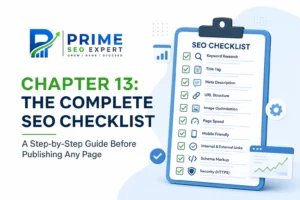
Learning SEO is important, but applying it consistently is what produces long-term results.
Many websites don’t struggle because they lack knowledge. They struggle because important optimization steps are forgotten during publishing or maintenance.
You might write an excellent article but forget to add internal links.
Your website may load quickly, but your images aren’t optimized.
Your content may target the right keyword, but your title tag isn’t compelling enough to earn clicks.
These small oversights can reduce your overall SEO performance.
That’s why professional SEO teams rely on checklists.
A structured SEO checklist helps ensure every page meets essential optimization standards before it goes live. Instead of relying on memory, you follow a proven process that improves consistency, quality, and search visibility.
Let’s walk through the complete checklist used before publishing or auditing a webpage.
Phase 1: Keyword Research Checklist
Every successful page begins with proper keyword research.
Before writing, confirm that you have:
| Task | Complete |
|---|---|
| Selected one primary keyword | ✅ |
| Identified related keywords | ✅ |
| Understood search intent | ✅ |
| Reviewed competitor pages | ✅ |
| Evaluated keyword difficulty | ✅ |
| Considered search volume | ✅ |
| Planned supporting topics | ✅ |
Without keyword research, content becomes guesswork instead of strategy.
Phase 2: Content Creation Checklist
Content should always prioritize users before search engines.
Before publishing, ask yourself:
| Task | Complete |
|---|---|
| Answers the user’s question completely | ✅ |
| Original and unique content | ✅ |
| Easy-to-read language | ✅ |
| Logical heading structure | ✅ |
| Short paragraphs | ✅ |
| Bullet points where helpful | ✅ |
| Practical examples included | ✅ |
| Information fact-checked | ✅ |
Every page should provide genuine value rather than simply repeating information found elsewhere.
Phase 3: On-Page SEO Checklist
Now optimize the page itself.
| Task | Complete |
|---|---|
| One H1 heading | ✅ |
| SEO-friendly title tag | ✅ |
| Meta description written | ✅ |
| Clean URL | ✅ |
| Primary keyword placed naturally | ✅ |
| Secondary keywords included | ✅ |
| Images optimized | ✅ |
| Alt text added | ✅ |
| Internal links added | ✅ |
| External references where appropriate | ✅ |
Each element helps search engines better understand your content.
Phase 4: Technical SEO Checklist
A technically healthy website gives your content the best chance to rank.
Confirm the following:
| Task | Complete |
|---|---|
| HTTPS enabled | ✅ |
| XML sitemap updated | ✅ |
| Robots.txt reviewed | ✅ |
| Canonical tags correct | ✅ |
| Mobile-friendly design | ✅ |
| Fast loading speed | ✅ |
| Core Web Vitals checked | ✅ |
| No crawl errors | ✅ |
| No broken links | ✅ |
| Structured data implemented | ✅ |
Technical issues often remain invisible to users but can significantly affect rankings.
Phase 5: Internal Linking Checklist
Internal links strengthen your website’s structure and topical authority.
Ask yourself:
| Task | Complete |
|---|---|
| Links to relevant articles | ✅ |
| Links from older pages added | ✅ |
| Anchor text descriptive | ✅ |
| No orphan pages | ✅ |
| Important pages easily accessible | ✅ |
Every new article should become part of your existing content network.
Phase 6: User Experience Checklist
SEO and user experience go hand in hand.
Review:
| Task | Complete |
|---|---|
| Mobile responsiveness | ✅ |
| Easy navigation | ✅ |
| Readable fonts | ✅ |
| Clear spacing | ✅ |
| Fast page loading | ✅ |
| No intrusive pop-ups | ✅ |
| Images display correctly | ✅ |
A positive user experience increases engagement and encourages visitors to stay longer.
Phase 7: EEAT Checklist
Before publishing, evaluate whether your content demonstrates trust and expertise.
| Task | Complete |
|---|---|
| Accurate information | ✅ |
| Helpful examples | ✅ |
| Clear author information | ✅ |
| Updated facts | ✅ |
| Trustworthy sources referenced | ✅ |
| Transparent claims | ✅ |
| Secure website | ✅ |
Remember that trust is one of the most important long-term SEO assets.
Phase 8: Link Building Preparation
Great content deserves promotion.
Before starting outreach, confirm:
| Task | Complete |
|---|---|
| Content provides unique value | ✅ |
| Linkable assets included | ✅ |
| Outreach list prepared | ✅ |
| Natural anchor text planned | ✅ |
| Promotion strategy ready | ✅ |
Link building becomes much easier when the content is genuinely worth referencing.
Phase 9: Performance Tracking Checklist
Publishing is only the beginning.
After publication:
| Task | Complete |
|---|---|
| Submitted to Google Search Console | ✅ |
| Indexed successfully | ✅ |
| Rankings monitored | ✅ |
| Traffic reviewed | ✅ |
| CTR analyzed | ✅ |
| Internal links updated | ✅ |
| Content refreshed periodically | ✅ |
Continuous monitoring helps identify opportunities for improvement.
The Ultimate SEO Workflow
A successful SEO campaign generally follows this sequence:
Keyword Research
        │
        ▼
Content Planning
        │
        ▼
Content Creation
        │
        ▼
On-Page SEO
        │
        ▼
Technical SEO Review
        │
        ▼
Internal Linking
        │
        ▼
Publish Content
        │
        ▼
Index in Google
        │
        ▼
Monitor Performance
        │
        ▼
Update & Improve
Following this workflow consistently reduces errors and creates a repeatable SEO process.
Common Checklist Mistakes
Even with a checklist, avoid these common habits:
- Publishing before proofreading.
- Forgetting internal links.
- Ignoring search intent.
- Skipping mobile testing.
- Never updating older content.
- Measuring rankings but ignoring conversions.
- Treating SEO as a one-time task.
SEO is an ongoing process of testing, learning, and improving.
Key Takeaways
- A structured checklist ensures consistency across every page.
- Successful SEO combines keyword research, technical optimization, quality content, and continuous monitoring.
- Publishing is only one stage of the SEO process.
- Regular updates help maintain rankings over time.
- Small improvements made consistently often produce significant long-term growth.
📌 Chapter Summary
An SEO checklist transforms knowledge into action. Instead of relying on memory or rushing through publication, it provides a repeatable framework that helps ensure every page is optimized for users and search engines alike. Following a consistent workflow reduces mistakes, improves quality, and increases the likelihood of long-term organic success.
💡 Pro Tip
Create your own publishing SOP (Standard Operating Procedure) based on this checklist. Every time you publish a new article, review each item before clicking “Publish.” Consistency is one of the biggest differences between average websites and high-performing authority websites.
What’s Next?
You’ve now learned the complete SEO process—from keyword research and technical optimization to content strategy, link building, Local SEO, and implementation.
In the final chapter, we’ll answer the most common SEO questions beginners and website owners ask. These FAQs will reinforce everything you’ve learned, target additional long-tail keywords, and help this Complete SEO Guide appear in Google’s People Also Ask results and featured snippets.
Chapter 14: Frequently Asked SEO Questions (FAQs)

After learning the fundamentals of SEO, many beginners still have practical questions about how search engines work, how long SEO takes, and which strategies actually produce results.
This FAQ section answers some of the most common questions website owners, bloggers, and businesses ask about SEO. Whether you’re just starting your journey or looking to improve your existing strategy, these answers will help reinforce the concepts covered throughout this Complete SEO Guide.
1. What is SEO?
SEO (Search Engine Optimization) is the process of improving a website’s visibility in organic search results. It involves optimizing content, technical performance, user experience, and authority so search engines can better understand and rank your pages.
2. Why is SEO important?
SEO helps businesses and website owners attract targeted organic traffic without paying for every click. It increases visibility, builds credibility, improves user experience, and supports long-term online growth.
3. How long does SEO take to show results?
SEO is a long-term strategy.
While some improvements may appear within a few weeks, meaningful results often take three to six months, and highly competitive industries may require even more time. The timeline depends on factors such as competition, website authority, content quality, and consistency.
4. Is SEO better than paid advertising?
SEO and paid advertising serve different purposes.
Paid ads provide immediate visibility, while SEO focuses on sustainable organic growth. Many successful businesses combine both strategies rather than relying on only one.
5. Can I learn SEO without technical knowledge?
Yes.
Many SEO fundamentals—including keyword research, content optimization, and internal linking—can be learned without advanced technical skills. More technical topics can be mastered gradually as your experience grows.
6. What is the difference between On-Page SEO and Off-Page SEO?
On-Page SEO focuses on optimizing elements within your website, such as content, headings, titles, URLs, and internal links.
Off-Page SEO focuses on external signals, including backlinks, brand mentions, and digital PR, that help build authority.
7. What is Technical SEO?
Technical SEO improves the infrastructure of a website so search engines can crawl, index, and understand pages efficiently. It includes areas such as website speed, mobile usability, HTTPS, XML sitemaps, structured data, and Core Web Vitals.
8. What are keywords in SEO?
Keywords are the words and phrases users type into search engines when looking for information, products, or services. Effective keyword research helps you create content that matches user intent.
9. What are long-tail keywords?
Long-tail keywords are longer, more specific search phrases with lower competition and clearer search intent.
For example:
- SEO
- Complete SEO Guide
- Complete SEO Guide for Beginners
Generally, longer and more specific keywords are easier for newer websites to target.
10. What is search intent?
Search intent is the reason behind a user’s search.
Understanding whether someone wants to learn, compare, buy, or visit a specific website helps you create content that better satisfies their needs.
11. What are backlinks?
Backlinks are hyperlinks from one website to another.
High-quality backlinks from relevant, trustworthy websites act as signals of authority and can improve your search visibility over time.
12. Are backlinks still important?
Yes.
Although Google’s algorithms have become more sophisticated, high-quality backlinks remain one of the strongest ranking signals when earned naturally through valuable content.
13. How often should I update my content?
Important pages should be reviewed regularly.
Refreshing outdated information, improving examples, adding internal links, and updating statistics helps maintain relevance and long-term performance.
14. Is duplicate content bad for SEO?
Duplicate content can create confusion for search engines and dilute ranking signals.
Whenever possible, create original content and use canonical tags appropriately if similar pages are necessary.
15. What is Local SEO?
Local SEO helps businesses appear in location-based searches such as:
- SEO agency near me
- Best restaurant in Lahore
- Plumber in Karachi
It focuses on optimizing your Google Business Profile, local citations, customer reviews, and location-specific content.
16. Which free SEO tools should I use?
Excellent free tools include:
- Google Search Console
- Google Analytics
- Google Keyword Planner
- Google Trends
- PageSpeed Insights
These tools provide valuable insights without requiring a paid subscription.
17. How many keywords should I target on one page?
Instead of focusing on a specific number, build your content around one primary keyword supported by several closely related secondary keywords and natural variations.
Modern search engines understand topics, not just exact-match phrases.
18. Does page speed affect SEO?
Yes.
Page speed influences user experience and is part of Google’s overall evaluation of website quality. Faster websites generally provide better engagement and lower bounce rates.
19. Can AI-generated content rank on Google?
AI can assist with research, outlining, and drafting, but content should always be reviewed, improved, and verified by a human before publication.
The focus should be on originality, accuracy, usefulness, and trustworthiness—not on how the content was created.
20. What is the most important SEO ranking factor?
There is no single ranking factor.
Successful SEO combines:
- Helpful content.
- Search intent.
- Technical SEO.
- User experience.
- High-quality backlinks.
- Internal linking.
- EEAT principles.
The best results come from improving all of these areas together rather than focusing on one element alone.
Key Takeaways
- SEO is a long-term investment that rewards consistency and quality.
- Understanding user intent is just as important as targeting keywords.
- Technical SEO, content quality, and backlinks work together to improve rankings.
- Regular updates and continuous learning are essential for long-term success.
- There is no shortcut to sustainable SEO growth.
📌 Chapter Summary
These frequently asked questions reinforce the core concepts covered throughout this guide and address many of the practical challenges beginners face. SEO is constantly evolving, but the principles of creating helpful content, optimizing your website, and building trust remain the foundation of long-term success.
💡 Pro Tip
Bookmark this guide and revisit it regularly. SEO evolves with search engines, user behavior, and technology. Reviewing your strategy every few months—and continuously improving your content—will help you stay ahead of competitors and maintain strong organic visibility.
Final Conclusion: Your SEO Journey Starts Today
You’ve now completed this Complete SEO Guide—from understanding how search engines work to mastering keyword research, On-Page SEO, Technical SEO, content strategy, link building, Local SEO, essential tools, and practical implementation.
The most important lesson is this:
SEO isn’t about tricking search engines. It’s about helping people.
When you create valuable content, organize your website effectively, provide a great user experience, and continuously improve your pages, search engines are more likely to reward your efforts with sustainable organic visibility.
Remember that SEO is a marathon, not a sprint.
Algorithms will continue to evolve, competition will increase, and new technologies will emerge. However, websites that prioritize quality, trust, and user satisfaction consistently outperform those chasing shortcuts.
Start with one page. Optimize it carefully. Measure the results. Learn from the data. Then repeat the process.
Small improvements, applied consistently over time, often produce extraordinary long-term results.
Thank you for reading this Complete SEO Guide. We hope it serves as a valuable reference throughout your SEO journey and helps you build a website that grows through ethical, sustainable, and user-focused optimization.