
Introduction
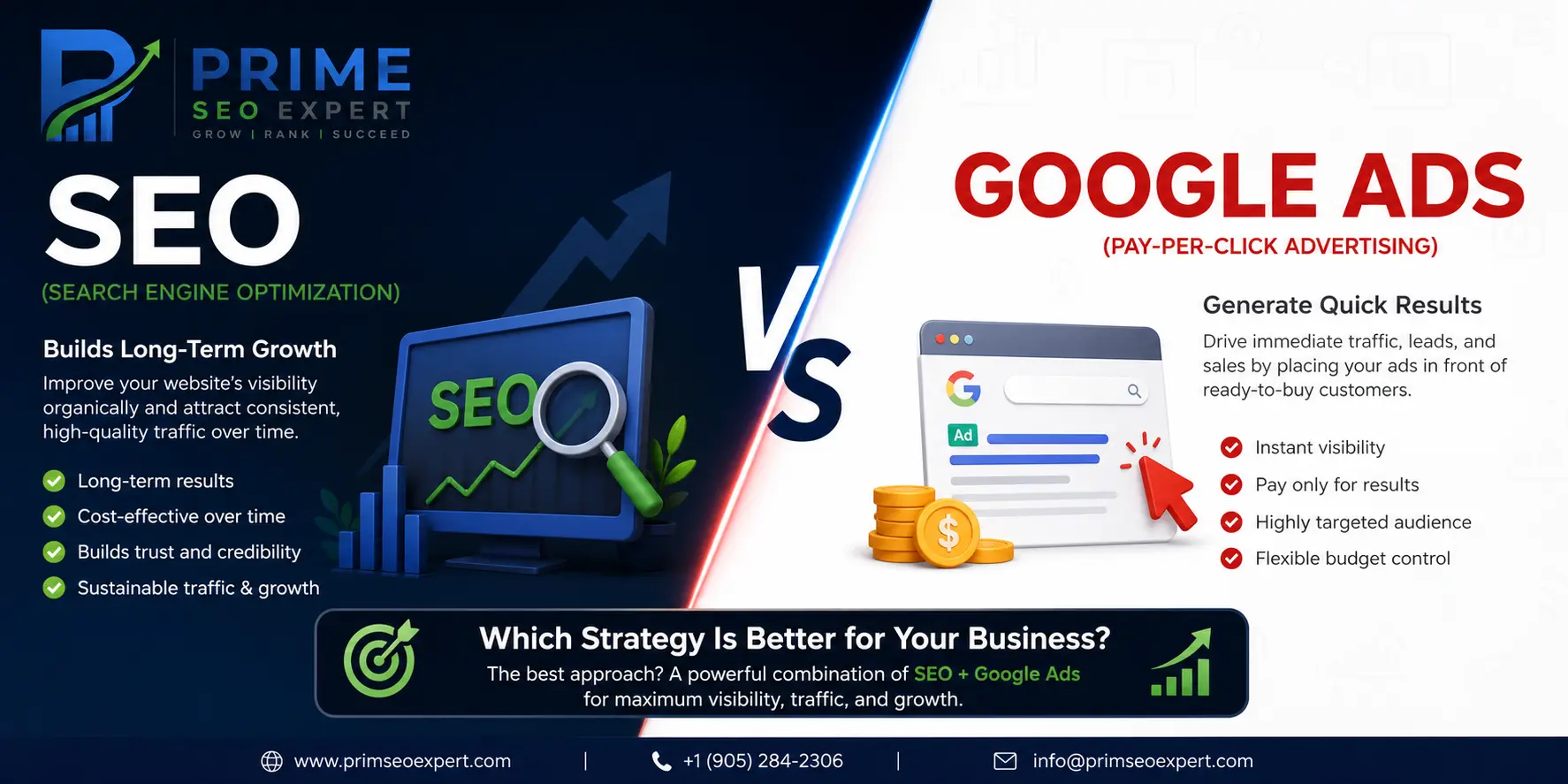
Businesses today have more ways than ever to attract potential customers online. Two of the most powerful options are Search Engine Optimization (SEO) and Google Ads. Both can help your business appear in search results, attract qualified visitors, and generate leads, but they work in very different ways.
So, when comparing SEO vs Google Ads, which strategy is better for your business?
The answer depends on your goals, budget, competition, website, and how quickly you need results. SEO is generally a long-term strategy designed to build sustainable organic visibility, while Google Ads can deliver targeted traffic much faster through paid search advertising.
Understanding the differences can help you decide where to invest your marketing budget—or whether combining both strategies is the better approach.
SEO vs Google Ads: What Is the Difference?
SEO focuses on improving your website so that it can rank higher in organic search results. It involves activities such as keyword research, content optimization, technical improvements, internal linking, local SEO, and authority building.
Google Ads, on the other hand, allows businesses to pay for advertisements that can appear above or alongside organic search results for selected keywords.
In simple terms:
- SEO: Build organic visibility over time.
- Google Ads: Pay for targeted search visibility.
- SEO: Focuses on long-term growth.
- Google Ads: Can generate traffic much faster.
- SEO: Requires ongoing optimization and quality content.
- Google Ads: Requires an advertising budget and campaign management.
Neither approach is automatically better for every business. The right choice depends on what you are trying to achieve.
How SEO Works for Businesses
SEO improves a website’s ability to appear naturally when people search for relevant products, services, or information.
A successful SEO strategy can include:
- Keyword research
- On-page SEO
- Technical SEO
- High-quality SEO content writing
- Internal linking
- Local SEO
- Authority link building
- SEO-optimized web design
- SEO audits
- Website optimization
- User experience improvements
For example, a local business may optimize its website for location-based searches, while an online business may target informational and commercial keywords through helpful content.
If you want to understand the broader process, our Complete SEO Guide provides a detailed overview of how different SEO activities work together.
Benefits of SEO
SEO can provide several long-term benefits:
Sustainable organic traffic:
Once pages establish strong organic rankings, they can continue attracting visitors without paying for every individual click.
Long-term visibility:
SEO can build a website’s presence across many relevant search queries.
Brand credibility:
Strong organic visibility can help establish trust and authority with potential customers.
Compounding growth:
A website can continue expanding its search visibility as it publishes useful content and improves existing pages.
However, SEO usually requires patience. Depending on the website, competition, industry, and strategy, meaningful results can take time.
How Google Ads Works for Businesses
Google Ads allows businesses to create paid search campaigns targeting specific keywords, audiences, locations, and other criteria.
When someone searches for a relevant term, your advertisement may appear when your campaign meets Google’s advertising and auction requirements.
Businesses can use Google Ads to promote:
- Products
- Services
- Local businesses
- Online stores
- Lead-generation offers
- Landing pages
- Special promotions
The major advantage is speed. Instead of waiting for a new page to earn organic rankings, a properly configured campaign can begin generating search visibility shortly after launch.
However, paid traffic comes with an ongoing advertising cost. When your campaign stops receiving budget, your paid search traffic can also stop.
SEO vs Google Ads: Key Differences
| Factor | SEO | Google Ads |
|---|---|---|
| Traffic type | Organic | Paid |
| Speed | Usually slower | Usually faster |
| Long-term value | High | Depends on continued spending |
| Cost model | Investment in optimization/content | Advertising budget |
| Results | Build over time | Can start quickly |
| Credibility | Organic visibility can support trust | Clearly identified as an advertisement |
| Scalability | Can grow through content and rankings | Scales with campaign budget and performance |
| Best for | Sustainable growth | Immediate targeted traffic |
The important point is that SEO and Google Ads are not necessarily competitors. They can work together as part of a broader search marketing strategy.
Which Is Better for Long-Term Growth?
For businesses focused on sustainable organic visibility, SEO is usually the stronger long-term investment.
A well-optimized page can continue attracting organic visitors after it has established rankings. Businesses can also build topical authority by creating useful content around related subjects.
For example, a company offering SEO services could create content around technical SEO, local SEO, content strategy, SEO audits, and link building. These pages can support each other while strengthening the site’s overall topical relevance.
SEO does require consistent effort, though. Publishing one article and expecting permanent rankings is not a realistic strategy. Search results change, competitors publish new content, and websites need ongoing optimization.
Which Is Better for Immediate Results?
If your priority is generating targeted search traffic quickly, Google Ads can have a significant advantage.
A business launching a new product, service, promotion, or landing page may not want to wait months for organic rankings. A well-planned Google Ads campaign can provide immediate opportunities to reach people actively searching for relevant solutions.
However, speed does not guarantee profitability.
Businesses still need to manage:
- Keyword targeting
- Ad copy
- Landing pages
- Conversion tracking
- Bidding
- Budget
- Negative keywords
- Quality and relevance
Poorly managed campaigns can spend money without generating enough valuable conversions.
SEO vs Google Ads: Which Is More Cost-Effective?
There is no universal answer.
SEO does not mean “free traffic.” It requires investment in strategy, content, technical improvements, optimization, and authority building.
Google Ads requires direct advertising expenditure, and costs can vary considerably depending on the industry and keyword competition.
For some businesses, Google Ads may generate profitable leads quickly. For others, building organic visibility may produce better long-term value.
The best approach is to measure return on investment (ROI) rather than simply comparing the cost of a click.
Should You Use SEO and Google Ads Together?
In many cases, yes.
Combining SEO and Google Ads can give businesses both short-term and long-term search visibility.
For example:
- Use Google Ads to generate immediate targeted traffic.
- Use SEO to build organic rankings over time.
- Analyze which keywords generate valuable conversions.
- Create or improve organic content around successful topics.
- Optimize landing pages for both paid and organic traffic.
- Continue measuring conversions and revenue.
This creates a more balanced search strategy instead of depending entirely on one traffic source.
Which Strategy Is Better for Small Businesses?
Small businesses should consider their goals, competition, budget, and location before choosing between SEO and Google Ads.
A local business may benefit significantly from Local SEO because customers often search for nearby services and businesses.
At the same time, Google Ads can help a small business reach potential customers who are actively searching for its services.
For businesses with limited budgets, the goal should not simply be to choose the cheapest option. Instead, focus on which strategy can produce the strongest return from the available resources.
How to Choose Between SEO and Google Ads
Ask yourself these questions:
Do you need traffic immediately?
Google Ads may be more suitable.
Are you focused on long-term organic growth?
SEO should be a major part of your strategy.
Are you launching a new website?
A combination of SEO and carefully targeted paid campaigns may work well.
Do you operate a local business?
Consider combining Local SEO with location-focused Google Ads.
Do you have a limited advertising budget?
Investing consistently in SEO and valuable content may provide stronger long-term benefits.
Do you have a time-sensitive promotion?
Google Ads can help you reach relevant searchers quickly.
Final Verdict: SEO or Google Ads?
When comparing SEO vs Google Ads, there is no single winner.
SEO is generally better for long-term organic visibility, sustainable traffic, authority, and ongoing search growth. Google Ads is better when you need targeted traffic quickly and have a budget for paid campaigns.
For many businesses, the smartest approach is not choosing one over the other. Instead, use Google Ads for immediate opportunities while building an SEO strategy that can produce sustainable organic growth over time.
The key is to connect both strategies to measurable business goals, conversions, and revenue rather than focusing only on traffic.